

Not every manufacturing partnership works the same way. Understanding the difference between engineering arrangements can help OEMs find the right manufacturer for their projects.
When it comes to manufacturing custom components, there's more than one way to design a product.
Some manufacturers take a concept and develop a solution around it. Others specialize in taking an already established design and turning it into a finished product.
Both approaches have their place, but understanding the difference between build-to-print and build-to-spec manufacturing can make a significant difference when choosing a manufacturing partner.
At SPF America, we are currently choosing to specialize in build-to-print manufacturing. It's an approach that allows us to focus on what we do best: manufacturing quality components according to our customers' designs and specifications.
So, what separates these two manufacturing arrangements, and why might one be a better fit for your project?
What Is BTP Manufacturing?
Build-to-print (BTP) manufacturing is an arrangement where a customer provides the drawings, specifications, and technical requirements needed to manufacture a component or assembly. Rather than developing the product design, the manufacturer is responsible for producing the part according to the customer's established requirements.
Think of it this way: You bring the blueprint.
We bring the manufacturing capabilities.
In a BTP arrangement, the customer typically maintains design authority and determines the product's intended function, dimensions, materials, tolerances, and performance requirements. In-house engineering teams may be necessary to maintain highly sensitive IPs.
The manufacturer's responsibility is to:
Review the supplied documentation for manufacturability
Clarify any questions
Communicate potential challenges
Suggest deviations to improve costs and lead times
Produce components that meet the agreed requirements
For OEMs with established engineering teams, this approach can be especially valuable.
When Is BTP Manufacturing Used?
Build-to-print manufacturing is commonly used when:
An OEM has an established product design that's ready for production.
A company needs custom components manufactured to specific dimensions and tolerances.
An engineering team wants to maintain control over product design and revisions.
A manufacturer is needed to support repeat production of existing parts.
A procurement team wants to qualify an additional supplier using established technical documentation.
FOR EXAMPLEAn OEM manufacturing electrical distribution equipment may have an engineered copper busbar design with specific material, geometry, hole placement, and finishing requirements.
Rather than asking a supplier to design the busbar, the OEM provides the drawings and specifications needed for production.
A BTP manufacturer can then manufacture the component according to those requirements.
This arrangement allows the OEM to retain control over its design while relying on the manufacturer's production capabilities.

What Is BTS Manufacturing?
Build-to-spec (BTS) manufacturing takes a different approach.
Instead of supplying a complete manufacturing design, the customer provides a set of requirements describing what the finished product needs to accomplish.
These requirements may include performance expectations, operating conditions, dimensional constraints, applicable standards, and other functional specifications.
The manufacturer then develops or completes the design needed to meet those requirements, depending on the agreed scope of responsibility.
In other words, the customer defines what the product needs to do, and the manufacturer determines a designed solution that meets those needs.
This arrangement typically involves greater design responsibility on the manufacturer's side.
When Is BTS Manufacturing Used?
Build-to-spec manufacturing is often useful when:
A company has identified a product need but doesn't have a completed design.
An OEM needs additional engineering or product development resources.
A project requires a manufacturer to develop a solution around performance requirements.
The customer wants to delegate some or all design responsibilities to a supplier.
A new product requires development, testing, and design validation before production.
For exampleAn equipment manufacturer might need a custom electrical assembly that meets specific performance and space requirements but doesn't have a finalized design.
A BTS supplier could help develop the assembly, select components, establish the design, and validate it against the agreed requirements.
This can be a practical arrangement for companies seeking both product development and manufacturing support.
BTP vs BTS: What's the Difference?
Although both arrangements can produce custom-manufactured products, the primary difference comes down to who is responsible for the design.
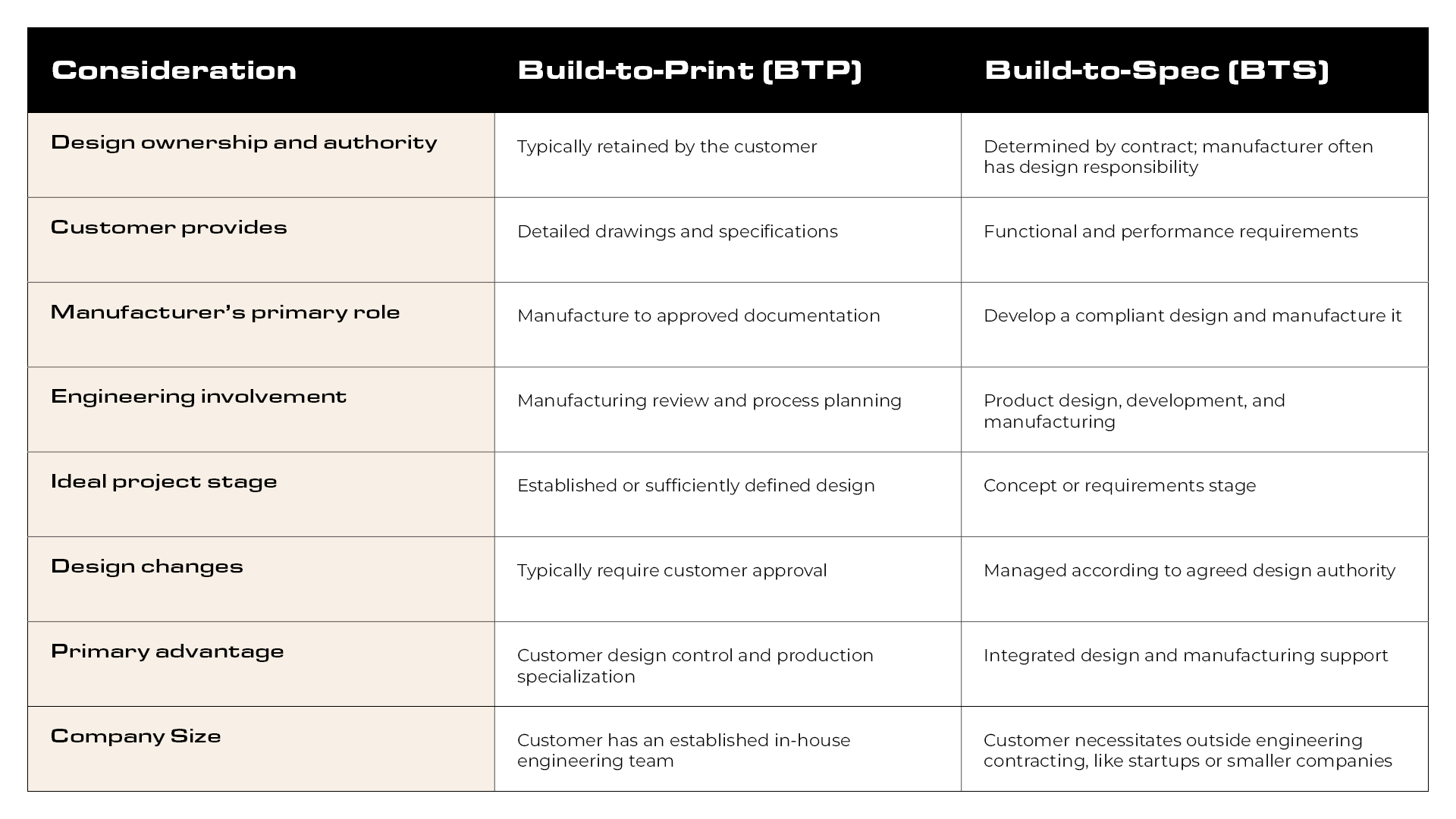
Neither arrangement is inherently better.
The right choice depends on the customer's internal resources, project requirements, and how much responsibility they need their manufacturing partner to assume.
Why SPF America Chooses Build-to-Print
At SPF America, we've spent decades building our experience around our customer needs.
We've learned that being a dependable manufacturing partner doesn't mean we need to design every product we produce. Sometimes, the greatest value we can provide is knowing exactly where our responsibilities begin and delivering on them consistently.
That's why we focus on build-to-print manufacturing.
-
Our customers know their products.
They understand the electrical, mechanical, and environmental requirements their equipment needs to meet. Their engineering teams make important decisions about product performance, safety, and application requirements.
Our role is to support those decisions through our manufacturing capabilities.
By working from customer-provided drawings and specifications, we allow OEMs to maintain control over their designs while taking advantage of our manufacturing capabilities.
We believe that makes for a strong partnership: each team contributing its own expertise toward a common goal, and clearly communicating throughout the process together.
-
Rather than positioning ourselves as a product design firm, we've invested in the processes and equipment needed to manufacture custom components.
Our vertically integrated capabilities include:
Cutting, stamping, punching, bending, + machining
Welding + sheet metal forming
Electroplating and powder coating
Insulation
Hardware insertion + assembly
Marking + kitting
In-house tooling production
Bringing these processes together allows us to support multiple manufacturing requirements within one organization.
For OEM procurement teams, that can mean fewer suppliers to coordinate, more direct communication, and a simpler purchasing process.
-
When a product has an established design, consistency matters.
You need confidence that the components you order will continue to meet your specified requirements.
Build-to-print manufacturing provides a defined technical reference for production, inspection, and communication.
Approved drawings, specifications, and revisions help establish clear expectations for both the customer and manufacturer. That clarity is especially valuable for OEMs sourcing repeat-production components and assemblies.
Although we can make any quantity of parts or components, especially for prototyping purposes, we’re also not a job shop. We build ourselves around our customers, meaning when we’ve earned the responsibility of a customer product line, we dedicate square footage and trained workers to that line.
Our vertical integration improves our customers’ consistency because we perform our manufacturing services in-house. Components and certain tooling could be outsourced, but our fabrication and assembly of the product is done completely in-house from mill-direct material. Oftentimes, we’re able to produce our own tooling and necessary manufacturing components needed to get the job done right.
-
Successful manufacturing relationships depend on communication and clearly defined expectations.
In a build-to-print arrangement, the customer generally maintains responsibility for the product design, while the manufacturer is responsible for meeting the agreed manufacturing requirements.
This doesn't mean manufacturing teams never ask questions or offer suggestions.
If a drawing presents a manufacturing challenge, a material requirement needs clarification, or a process adjustment could improve production efficiency, communication is essential to making sure the blueprint and design intentions are clear.
Our team can review manufacturing requirements and discuss potential production considerations or options with customers.
However, changes affecting the approved design remain subject to the customer's authorization.
We believe that respecting these boundaries helps build trust between engineering, procurement, and manufacturing teams.
Does Build-to-Print Mean There’s No Collaboration?
Not at all.
One common misconception about build-to-print manufacturing is that the manufacturer simply receives a drawing and begins producing parts without further discussion. In practice, communication is the most important part of the process, and what any respectable manufacturer would practice.
A manufacturing team should identify questions involving tolerances, material availability, tooling, finishing requirements, or production methods.
Addressing these questions before production can help avoid unnecessary delays, misunderstandings, and rework.
For exampleA quote could be started, but there are discrepancies in the drawing. A part could be under or over-engineered, and we may need to discuss deviations for manufacturability, cost savings, and lead time improvements.
Coordinating those processes requires a clear understanding of the customer's requirements.
A build-to-print manufacturer can contribute manufacturing knowledge without taking ownership of the customer's product design.
Collaboration in build-to-print manufacturing means working together to manufacture an established design successfully.
Who Benefits Most From BTP Manufacturing?
Build-to-print manufacturing is particularly well suited for OEMs that have established engineering capabilities and need a dependable production partner.
-
Companies that already employ product engineers often prefer to maintain direct control over their designs.
Build-to-print manufacturing allows these teams to focus on product development and performance while relying on external manufacturing capabilities for component production.
-
For products that have already been developed and approved, outsourcing manufacturing can be a practical way to support ongoing production.
Build-to-print suppliers can manufacture components using established drawings and specifications without requiring a new design process.
-
OEM procurement teams often source components requiring several manufacturing operations.
Working with a vertically integrated build-to-print manufacturer can help consolidate processes such as fabrication, finishing, and assembly.
This may reduce the number of separate suppliers and purchasing activities involved in bringing components into production.
-
Even companies with internal manufacturing operations may need additional production capacity.
A build-to-print supplier can provide manufacturing support for existing designs, subject to tooling, qualification, capacity, and production requirements.
This arrangement can be particularly useful when an OEM needs to supplement its manufacturing resources without transferring product design responsibility.
Choosing the Right Manufacturer
Choosing between build-to-print and build-to-spec manufacturing ultimately comes down to what your project needs.
If you're starting with a concept and your team needs help developing a functional product, a build-to-spec arrangement may provide the engineering and development support you're looking for. If your team already has the means to create an established design and only needs a manufacturer capable of producing components to your requirements, build-to-print may be the better fit.
For OEMs in power generation, industrial battery, energy storage, telecommunications, and electrical distribution, build-to-print manufacturing can offer a practical way to source custom metal components while maintaining design control.
We don't necessarily believe we need to be everything to everyone. We believe in understanding our strengths, respecting our customers' expertise, and doing our part well.
You know what your product needs to accomplish. We know how to manufacture components to your approved specifications.
And that's the kind of partnership we're proud to build.
Looking for a BTP Manufacturing Partner?
SPF America supports OEMs with custom copper and aluminum busbars, precision metal fabrication, electroplating, powder coating, and assembly services.
With vertically integrated manufacturing capabilities and decades of experience, we work with customer-provided drawings and specifications to help bring established designs into production.